

Introduction
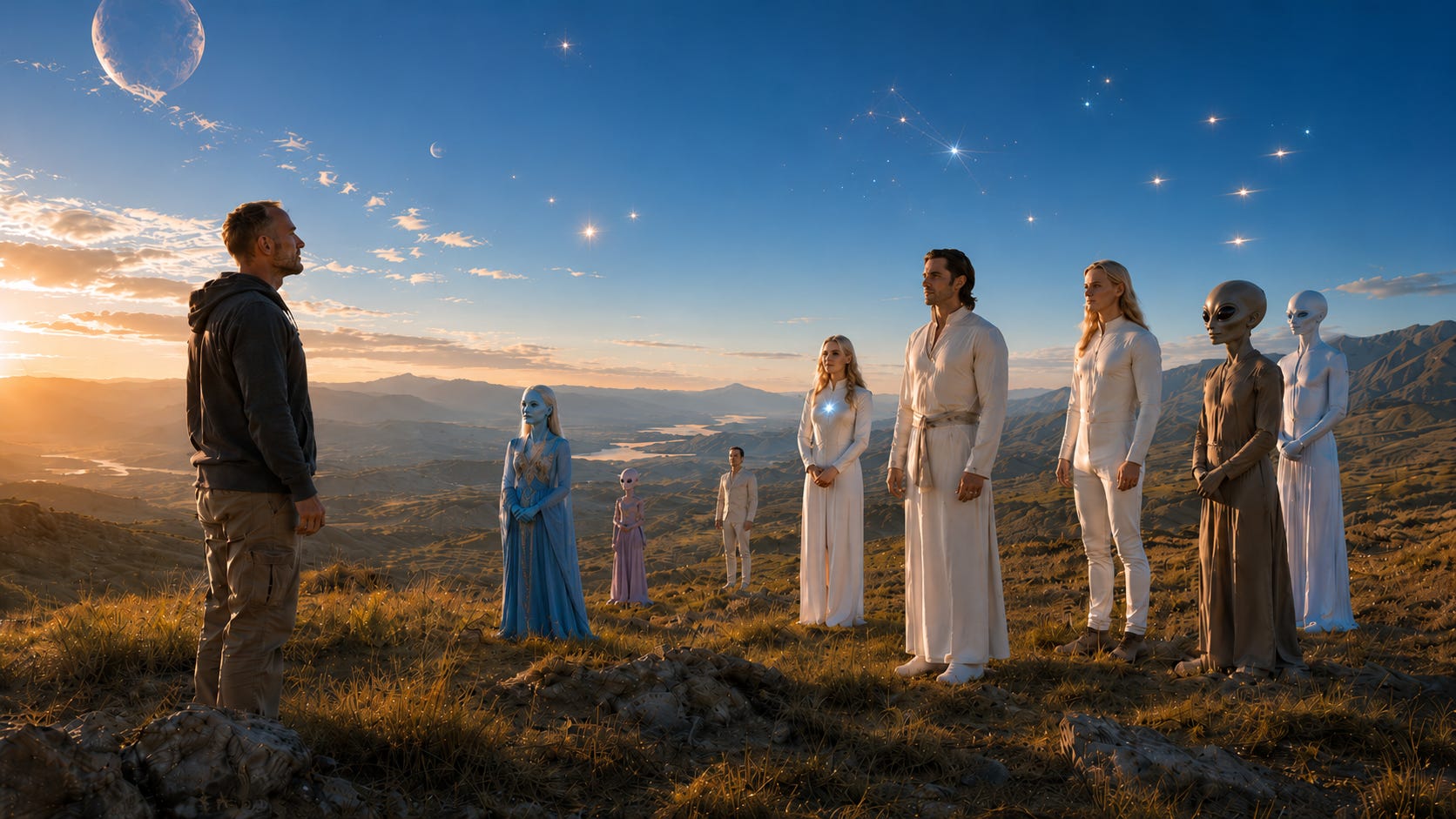
Are we ready to meet them?
Not just in the sense of whether governments, institutions, or scientific communities are ready to acknowledge life beyond Earth. I mean something more vulnerable.
Are we emotionally and spiritually mature enough as a planetary civilization to meet people from other worlds without immediately turning them into gods, monsters, saviors, celebrities, or symbols of our own fear?
Recognizing What Does Not Look Like Us
Another important question that deserves attention when thinking about contact is whether we are prepared to recognize forms of intelligence that do not resemble human life. My answer is yes and no.
I believe there are many people on this planet who are emotionally, intellectually, and spiritually prepared for contact. Some have gone through deep life experiences that have softened them, matured them, humbled them, and opened them. Others may have been naturally ready from a young age.
But as a collective, I think it’s a bit more complex. Here’s why.
Part of the ego’s responsibility is to protect us from what it believes is a threat. That protection can be useful. If something dangerous is happening, the ego can help us respond quickly. But the ego can also react with fear when something simply feels unfamiliar or we are being asked to move outside our comfort zone. The ego does not naturally seek change.
That being said, if something does not match the forms, behaviors, or realities we already understand, then the ego may interpret it as danger even when danger is not present. I had an experience in a dream a number of years ago that helped me understand this in a very direct way.
In the dream, I saw two beings walk past my bedroom. They were wearing silvery, tight-fitting suits, almost like jumpsuits. They were bald, and their eyes were very large. They did not threaten me. They did not attack me. They did not show any indication of harm.
They simply walked by.
But in the dream, I panicked. I got out of bed and chased after them. They went through a door into my bathroom, and when I opened the door, they were gone. It felt as if they had returned to wherever they came from.
When I woke up, my body was still asleep, but my awareness had snapped awake with a level of fear I had never felt before.
What stayed with me was not that they had done anything frightening. They had not. What stayed with me was how strongly my own system reacted to their presence. It felt like I had encountered an intelligence or form of life that my human mind did not know how to process.
That dream taught me something about contact. Sometimes the fear may not come from what is happening. It may come from the part of us that does not yet know how to recognize what is standing in front of us.
Fear, Invasion, and the Collective Ego
When we look at popular culture, alien contact is often associated with fear, invasion, abduction, nefarious experimentation, destruction, or the loss of human control. Of course, there are exceptions. Some stories are beautiful, curious, or compassionate.
However, many of the images we have inherited around extraterrestrial life are rooted in threat. I think there is a reason those stories have been so common. They reflect the part of humanity that is still afraid of moving from separation into unity.
If our collective ego is built around division, control, competition, and survival, then contact with a larger cosmic reality can feel threatening. It challenges the ideas that we are separate and that humanity is the center of existence.
So we project fear onto the unknown.
We imagine invasion because we still invade each other.
We imagine domination because we still dominate each other.
We imagine control because control is still one of the main ways humanity organizes power.
That does not mean every fear is irrational. Discernment and boundaries are necessary. Not every being, human or otherwise, should be blindly trusted. But if fear is the only lens we have, then even peaceful contact may only be interpreted through suspicion.
If we cannot recognize the difference between real danger and unfamiliarity, we may mistake a doorway for a threat. That is one of the reasons emotional maturity matters.
Identity Shock
Even for people who already believe life exists beyond Earth, there is a difference between belief and direct confirmation. It is one thing to say, “I believe they are out there.” It is another thing to know, without question, that life beyond Earth is real and present.
That kind of realization would affect more than science. It would affect religion, history, culture, politics, art, technology, and the way we understand our individual and collective identity as a human race. Once humanity moved through the initial shock, we would be invited into a larger understanding of what it means to exist. We would have to begin seeing ourselves not only as citizens of nations, cultures, or belief systems, but as part of a larger cosmic community.
Religion, Meaning, and Reinterpretation
Another question that often comes up around confirmed contact is how organized religion would respond.
My guess is it would probably depend on the religion, the community, the leadership, and the individual person. Some people might feel threatened. Others might feel expanded. Some teachings might be reinterpreted. Others might not have to change as much as people expect.
I grew up Catholic, though I do not currently identify with one specific religion. In the Catholic worldview I grew up around, there is one God, and God created life. From that perspective, people from other worlds and beings from other dimensions could simply be understood as more of God’s creation.
For some communities, contact might require a major theological shift. For others, it might deepen their understanding of creation rather than destroy it. The question may not be whether religion can survive contact. The question may be whether religion can grow with patience, compassion, and humility for itself.
Ultimately, if our spiritual frameworks are rooted in love, awe, mystery, and the sacredness of life, then contact will not destroy those frameworks. It will invite them to grow.
Would Humanity Unite or Divide?
My honest answer is probably both. At first, I think we would divide. We are conditioned to do that. We divide over politics, religion, identity, ethics, culture, history, science, and even sports teams. It is not realistic to think that humanity would suddenly become unified overnight.
But I believe contact will plant a seed that grows over time. The first generation may struggle with the shock. The next generation may grow up with the reality of contact as part of their worldview. Younger generations may help normalize a shared cosmic heritage in a way older generations could not fully embody at first.
Humanity will just need time to metabolize the truth. We will need the space to move from fear into curiosity, from control into cooperation, and from separation into a larger identity.
The Rock Star Illusion
Years ago, I was in Los Angeles for an award show where different artists and fans came together to celebrate music. During that time, I had the opportunity to meet one of my favorite singers. He had been in bands that were very important to me when I was younger. I also met one of the musicians who had originally inspired me to start playing music.
When I was a teenager and in my early twenties, I had placed these people on a pedestal. In my mind, they were larger than life. Metal gods. Rock gods. People who seemed almost untouchable because their music had meant so much to me.
Then I met them. And I realized they were just people. Talented people. Creative people. People who had made art that impacted my life. But still people.
That experience helped me understand something I now apply to contact. It is easy to place beings from other worlds or other dimensions on a pedestal. It is easy to make them into gods, saviors, or perfect beings who are somehow above us. It is also easy to do the opposite and make them into threats, monsters, or invaders. But maybe the healthier place is somewhere in the middle.
They are people too.
Different from us, sure. More advanced in certain ways, yes. Operating from higher frequencies or different forms of consciousness, absolutely. But still beings with their own lives, their own responsibilities, their own cultures, their own relationships, and their own way of existing. That perspective helps me stay grounded.
If I ever found myself in a physical contact experience, I would definitely be excited and in awe. But part of me also hopes I would be able to meet them with enough neutrality and humility to say something simple like:
“Welcome. It’s nice to meet you. How can I help?”
Maybe that sounds funny, but I think there is something important in it. It brings contact back to relationship. It brings the unknown back into the heart. At the end of the day, if all life is connected through consciousness, then they are not above us and we are not beneath them.
Art, Music, and the Creative Heart
One of the areas where I feel the most excitement about contact is how we will interpret the experience creatively.
If humanity openly acknowledged people from other worlds or beings from other dimensions, I believe art, music, storytelling, architecture, film, design, and spiritual expression would evolve in profound ways.
Even the idea of contact already inspires us. Science fiction, fantasy, mythology, spiritual writing, music, and visual art have all been shaped by the possibility that we are not alone.
Imagine what would happen if that possibility became part of our shared reality. Our collective creative heart would evolve. New symbols would emerge. New stories would be told. New music would be written. New ways of imagining Earth, humanity, and our place in the cosmos would begin to take form.
I think about cities filled with murals that celebrate life, nature, animals, Earth, and peaceful contact. I think about art that shows humanity not as a frightened species hiding from the universe, but as a young civilization learning how to participate in it.
There would be grief in that transition too. There would be confusion. There would be fear. But there would also be beauty. Contact could remind us that creativity is not just entertainment.
It would also help us remember collectively that creativity is one of the most powerful tools we have for moving through difficult periods of transition.
Are We Mature Enough?
Are we emotionally and spiritually mature enough for true inter-species dialogue? On a planetary scale, I do not think we are there yet. I believe many people are doing the inner work and becoming seeds for the evolution of human awareness. But collectively, we still have work to do.
True inter-species dialogue would require more than curiosity. It would require humility, emotional regulation, respect, and the ability to listen without immediately projecting our fears, fantasies, hierarchies, and expectations onto the beings we are meeting.
It would require us to stop asking only, “What can they give us?”
And begin asking:
“How can we meet them responsibly?”
It would also require us to look at how we already treat life on Earth. How do we treat each other? How do we treat animals? How do we treat the planet? How do we treat people who look, think, believe, speak, or live differently than we do?
Because if we cannot meet the diversity already present on Earth with openness and humility, how prepared are we to meet diversity from beyond Earth?
Preparation for contact begins with how we meet the life already in front of us.
Thanks for reading and have a great present moment!
Matt
Editor’s note: This article was adapted from a Planet Phoenix video transcript and edited by Matt McGee with assistance from AI.